Flooding from heavy rainfall represents the chief physical hazard to U.K. data centers designed to train large AI models, while storms present the greatest risk to facilities of the country’s listed companies.
Those are among the findings from the latest edition of the Institute’s Transition Finance Tracker, which arrives in the run-up to London Climate Action Week and spotlights the market for adaptation and resilience solutions, exposure to physical risk in the U.K. and beyond, a growing gap in homeowners’ insurance in the U.S., and the paradox of air conditioning as a climate solution.
Here are five highlights:
Which physical hazards pose the greatest risk to U.K. AI data centers?
Flooding from heavy rainfall represents the chief physical hazard to data centers in the U.K. designed to train large AI models. One — Waltham Cross — is currently operational; the other nine are under construction or planned. Three locations — Hillingdon, Newham and Long Drax — could face significant disruption in a once-in-a-hundred-year weather event.
Top physical hazard by AI data center location
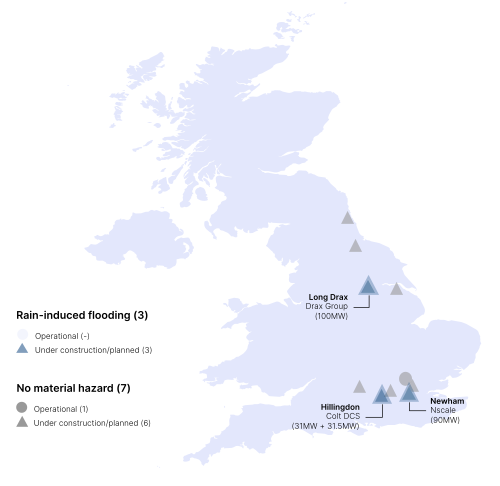
Source: Data centers and construction status from MSCI’s Real Capital Analytics dataset, covering roughly 9,000 data-center assets, and additional research, as of June 12, 2026. MSCI Sustainability & Climate Research geospatial return-period (RP) physical-risk data, showing the greatest financial impact per site among tropical cyclone and coastal, fluvial and pluvial flooding hazards, which are in scope of MSCI’s RP-100 business-interruption loss estimates. MSCI’s RP-100 business-interruption loss estimates, based on a current-policies scenario, show how much of a site’s annual revenue could be lost in a one-in-a-hundred-year event (annual probability of 1%), as of June 12, 2026.
Where are U.S. homeowners unable to renew insurance policies?
In the U.S., property insurers appear to be retreating from counties where exposure to acute hazards such as wildfire, tropical storms, and rain-induced and coastal flooding is highest. Nonrenewal rates roughly doubled in the highest-risk counties between 2018 and 2023.
Home-insurance nonrenewal rates in U.S. counties by physical-risk tier
Source: MSCI Sustainability & Climate Research average hazard percentile data based on wildfire, fluvial, pluvial and coastal flooding, and tropical cyclones for U.S. counties, as of June 12, 2026. These estimates are based on a current policies scenario. Non-renewal data from “’Insurance Company Climate Crisis,” U.S. Senate Budget Committee, December 2024, showing per-county yearly nonrenewal counts and policies in force. Analysis covers 3,102 counties matched across the two datasets.
How could demand for cooling impact the electricity grid?
The AI data-center boom gets the headlines, but space cooling is projected to drive more new electricity demand by 2030. Global electricity demand is projected to grow by roughly 6,750 TWh between now and 2030, according to the International Energy Agency. Of that growth, electric vehicles account for 838 TWh, space cooling for 651 TWh, and data centers for 530 TWh — suggesting that adapting to a warming world may be at least as important as the energy transition and the AI build-out in shaping the grid.
Projected growth in energy demand by driver 2024-2030 (TWh)
Source: “Energy and AI,” International Energy Agency, April 10 2025 (Base Case Scenario 2024–2030).
How have providers of adaptation and resilience solutions performed?
Among listed large- and mid-cap companies, companies with revenue from adaptation and resilience solutions performed only slightly better (+65%), on average, compared with non-providers (+59%), over the 29 months ended May 31, 2026.
Note that revenue from adaptation and resilience solutions may constitute either an insignificant share of solutions providers’ overall revenue. The chart shows who is in the market for adaptation and resilience, not who specializes in it. The cohort is overrepresented in the financials, industrials and utilities sectors, which rallied in the second half of the period, and underrepresented in consumer discretionary, consumer staples and energy sectors, which fell over the same time.
Monthly stock returns (%)
Source: MSCI Sustainability & Climate Research, based on companies in the MSCI ACWI Index as of May 31, 2026. Monthly returns are based on USD gross amounts, including dividends. Companies providing adaptation and resilience solutions are defined as companies with at least one adaptation or resilience solution among their products and services, as disclosed in their reporting across 10 adaptation themes (flood, drought, wildfire, cyclone/hurricane/storm, sea-level rise, extreme heat, hailstorm, landslide, extreme cold, and cross-sectional) in MSCI’s Adaptation and Resilience Metrics dataset (simulated results) for the calendar year 2025. Cohort monthly returns are computed as the simple cross-sectional average of constituents’ monthly USD total returns, then compounded and rebased to 100 as of Jan. 31, 2024.
Which industries are providing adaptation and resilience solutions?
Providers of adaptation and resilience solutions span industries. Overall, we see about 39% of large- and mid-cap listed companies globally providing at least one adaptation and resilience solution. The insurance (77%), capital goods (69%) and telecommunication services (68%) industries have the highest share.
Top adaptation and resilience providers by industry group (%)
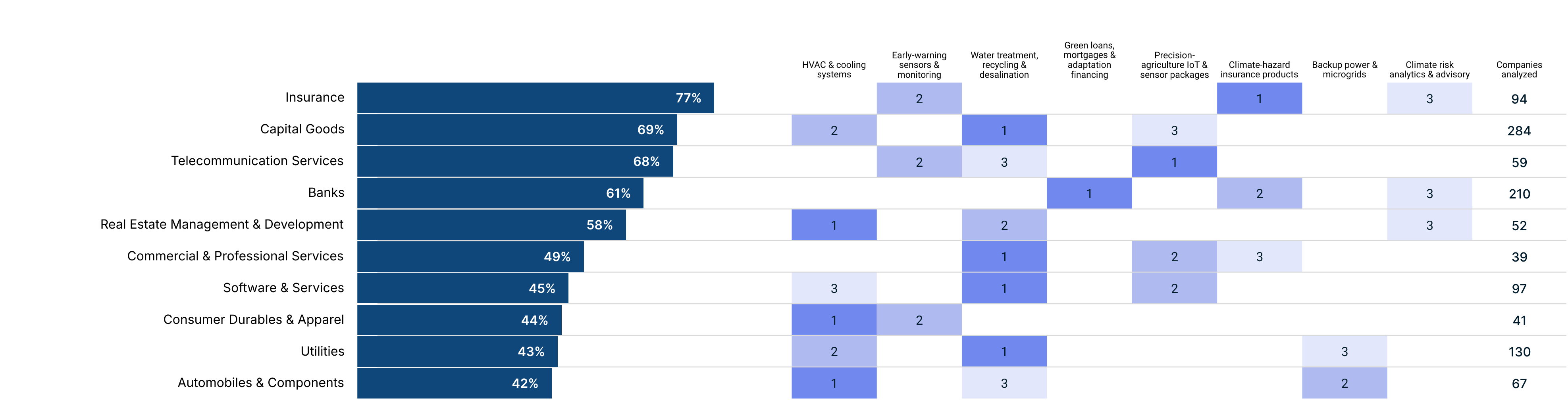
Source: MSCI Sustainability & Climate Research, based on MSCI‘s Adaptation and Resilience Metrics dataset (simulated results) and companies in the MSCI ACWI Index as of June 12, 2026. Sectors reflect Global Industry Classification Standard (GICS®) jointly developed by MSCI and S&P Dow Jones Indices.