From mapping corporate capital spending to measuring corporate resilience to climate-amplified weather events, the Institute’s inaugural Research Challenge showcased university students leading projects designed to bridge real-world gaps in sustainability data.
Student-researchers worked under the supervision of MSCI analysts, who provided resources and guidance to support the research. Here are highlights of the projects, which were led by nine student-researchers from five universities.
Overview of projects
| Topic | Supervisor | Description |
|---|---|---|
| Mapping green capital expenditures across key industries | Tanguy Séné | Assess how companies in different industries report capital spending (capex) tied to environmentally sustainable initiatives. |
| Examining evidence for sustainability and financial materiality | Liz Houston | Investigate the link between sustainability and financial outcomes across industries. |
| Assessing the readiness of energy transition technologies | Mathew Lee | Research the commercial readiness of emerging energy-transition technologies. |
| Comparing emissions reporting across regions | Siping Guo | Compare emissions reporting under different regulatory frameworks. |
| Measuring corporate resilience to climate-amplified disasters | Umar Ashfaq, Sophia Radis | Develop a framework to assess how companies prepare for physical climate risks such as floods, hurricanes and heat waves. |
Key takeaways
Neha Arora, a master’s student in sustainability management at Columbia University, identified three tiers of disclosure in the packaging industry.
- Best performers — that quantify green capex.
- Moderate performers — that disclose projects qualitatively without aggregated figures.
- Low performers — that provide vague narratives without specifics.
Her research showed that most green investments by packaging companies focus on day-to-day operations rather than long-term capital-intensive projects.
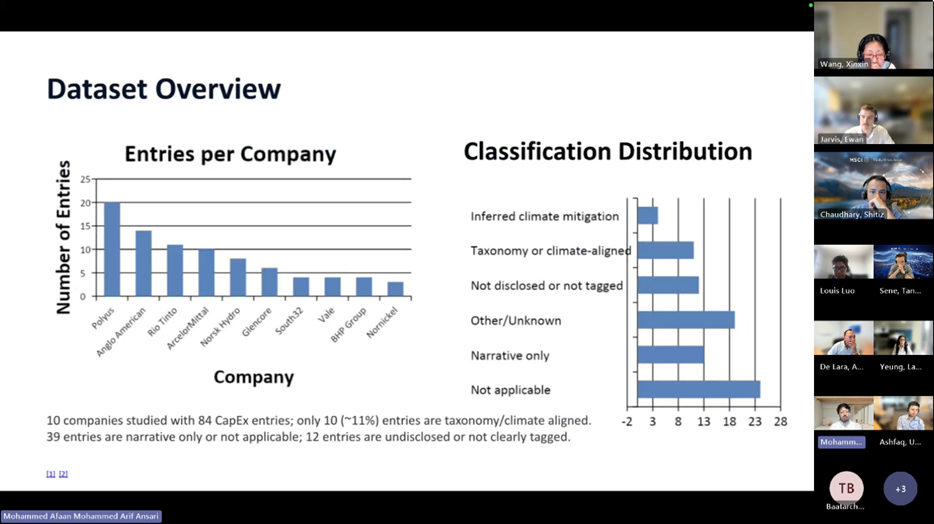
Mohammed Afaan Ansari, a master’s student in computer science at the University of Maryland, developed an AI framework using open-source large language models to pull capex data from mining company reports. Applying it to 10 companies, he extracted data in 84 categories and found that disclosures are often narrative rather than numerical, with little clear classification, making comparisons difficult.
Mapping green capital expenditures across key industries
The project explored how companies across industries report capital spending on environmentally sustainable initiatives — often called “green capex.” Students reviewed company filings and disclosures to identify indicators used to track such spending.
Key takeaways
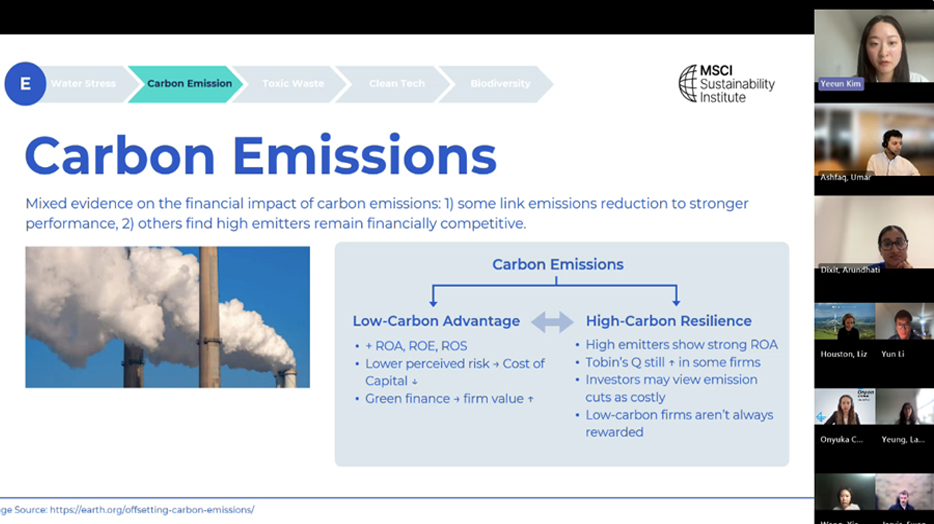
Yeeun Kim, a master’s candidate in environmental management at Duke University, examined five environmental factors and their impact on corporate performance. She found that cutting carbon emissions can boost returns on assets and equity, though some high-emitting companies still maintain strong valuations.
Arundhati Dixit, a master’s candidate at Columbia Business School, found that how companies manage human capital affects financial outcomes such as profitability and productivity, while also helping reduce risk. Her research suggests that factors such as executive pay and unionization yield mixed or context-dependent results.
Examining evidence for sustainability and financial materiality
This project investigated the link between sustainability and financial outcomes across industries. Students conducted a literature review to identify academic research connecting sustainability with business performance.
Assessing the readiness of energy transition technologies
This project examined the readiness of emerging energy-transition technologies for commercial use. Student researchers looked at cost competitiveness, decarbonization potential, market adoption and the maturity of resources and supply chains.
Key takeaways
Ketki Savant, a master’s student of quantitative economics at the University of California, Los Angeles, explored the commercial readiness of decarbonization technologies in hard-to-decarbonize industries. She found that few technologies have reached true cost parity; near-term progress depends on practical solutions, while large-scale transformation will require advances in carbon capture and green hydrogen, together with supportive policy frameworks.
Onyuka Chinbat, a master’s candidate at Columbia Business School, researched decarbonization in the glass, aluminum, auto and nuclear power industries, updating earlier assessments with new evidence. She found that companies and investors should not expect electric vehicles to achieve complete emissions abatement; decarbonizing light transport fully will also require decarbonization of EV supply chains and a modernized grid.
Key takeaways
Louis Luo, a master’s student in public administration at Columbia University, analyzed carbon accounting frameworks in the aluminum sector, with a focus on China, which produces about 60% of the world’s aluminum. Comparing approaches such as the Greenhouse Gas Protocol, International Aluminum Institute standards, ISO 19664, the UN’s Intergovernmental Panel on Climate Change, and the emissions trading systems of both the EU and China, he concluded that China’s ETS is the best compliance fit for domestic producers given the scale of its industry, while international frameworks support global alignment.
Yun (Leo) Li, a master’s student of sustainable finance at the University of Michigan, studied the cement industry, among the most emissions-intensive sectors, with China producing about half of global supply. His research found that while most frameworks focus on emissions from calcination and fuel combustion, China’s approach also accounts for non-carbonate raw materials and alternative clinkers. National policies there explicitly promote the use of alternative raw materials and carbon reduction in cement.
Comparing emissions reporting across regions
This project compared emissions reporting under different regulatory frameworks. Students explored how country-level approaches align with global standards, identifying alignment and gaps across high-emitting sectors.

Measuring corporate resilience to climate-amplified disasters
This project developed a framework to assess how companies prepare for physical climate risks such as floods, hurricanes and heat waves. Students reviewed industry practices and corporate disclosures to identify resilience strategies and measures.
Key takeaways
Turner Watkins, a master’s candidate in sustainability management at Columbia University, studied regulations on physical climate hazards affecting commercial real estate in New York, New Jersey and Connecticut, aiming to understand the regulatory landscape as a means to assess preparedness. Rising sea levels and new development in flood plains highlight real estate’s exposure to flooding and extreme heat, according to the research, which shows that most vulnerable buildings predate modern resilience codes. While retrofitting is costly and underincentivized, lessons from other U.S. markets suggest that grants, rebates and low-cost loans can help accelerate upgrades.