Investors in bond markets appear to reward municipalities that spend more on adapting to wildfire risk with lower borrowing costs, while corporate buyers of carbon credits are easier to identify by whether they buy than by what they buy.

Sydney Paul (left) and Olivia Mortimer
Those are the findings of Sydney Paul and Olivia Mortimer, respectively, master’s students at the University of Edinburgh’s Business School, who analyzed both topics as part of the MSCI Institute’s Scholars Program, which supports research by master’s-level students into tackling systemic challenges through capital markets.
The findings point to the value — and limits — of using data to understand how climate-related risks and actions show up in financial decisions. One study finds that spending on fire protection is associated with lower borrowing costs for California municipalities exposed to wildfire risk. The other finds that characteristics of companies can help explain which firms participate in the voluntary carbon market, but reveal much less about the credits they choose.
Here’s a look at the top-line findings from each.
Investing in wildfire protection may lower borrowing costs
Title: Wildfire Exposure Effects on Municipal Bond Yields in California
Author: Sydney Paul, University of Edinburgh
Faculty adviser: Luca Taschini, Professor and Chair of Climate Change Finance, University of Edinburgh
MSCI adviser: Katie Towey, Climate Specialist
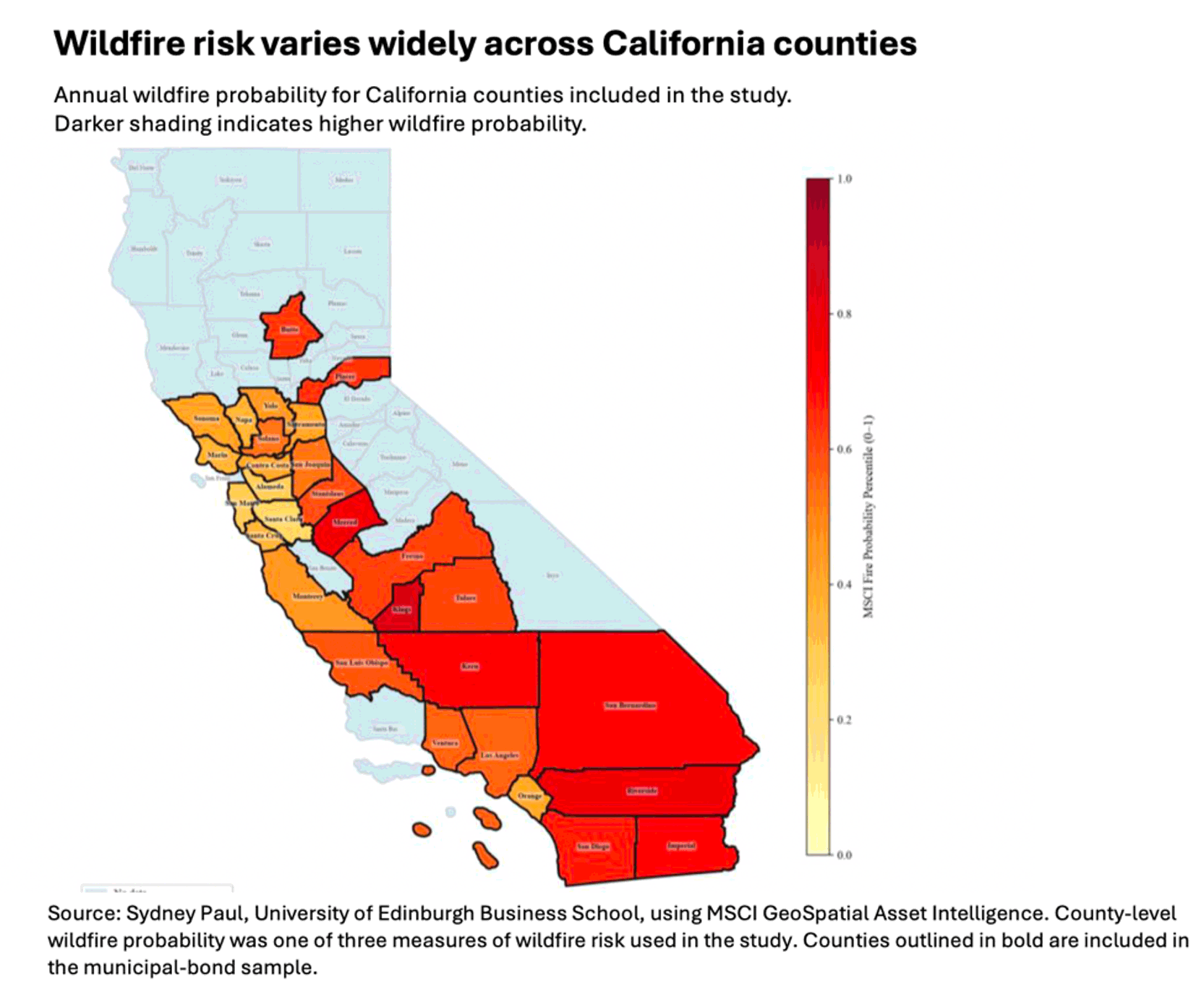
Paul examined more than 2,300 tax-exempt municipal bonds issued in California between 2001 and 2022 to ask whether wildfire exposure affects how much municipalities pay to borrow. She compared bond yields with three different measures of wildfire risk, including one from MSCI, while accounting for factors such as drought conditions, bond characteristics and local spending on fire protection.
Across all three measures, municipalities with greater wildfire exposure tended to face higher borrowing costs. But that relationship weakened once Paul accounted for local house prices, which can reflect both a community’s exposure to wildfire and its broader financial strength. That made it difficult to determine how much of the higher borrowing cost was attributable to wildfire risk alone. One of those measures, MSCI’s wildfire probability, shows how exposure varies across the California counties in the study.
The clearer finding involved adaptation. Municipalities that spent more on fire protection consistently tended to have lower borrowing costs. Across Paul’s analyses, greater fire-protection spending was associated with borrowing costs that were roughly 9 to 22 basis points lower, suggesting that investing in resilience may carry financial benefits as well as help communities prepare for wildfire. “The most robust finding is the fire expenditure variable, suggesting that investors reward municipalities that invest in wildfire mitigation,” she writes.
The findings suggest that the financial benefits of adaptation may extend beyond reducing physical damage. Investment in resilience could also be associated with a lower cost of raising capital.
Who buys carbon credits is easier to explain than what they buy
Title: Modeling Corporate Demand in the Voluntary Carbon Market
Author: Olivia Mortimer
Faculty adviser: Lavinia Rognone, Assistant Professor of Sustainable Finance, University of Edinburgh
MSCI adviser: Felix Hart, Head of Corporate Data, MSCI Carbon Markets
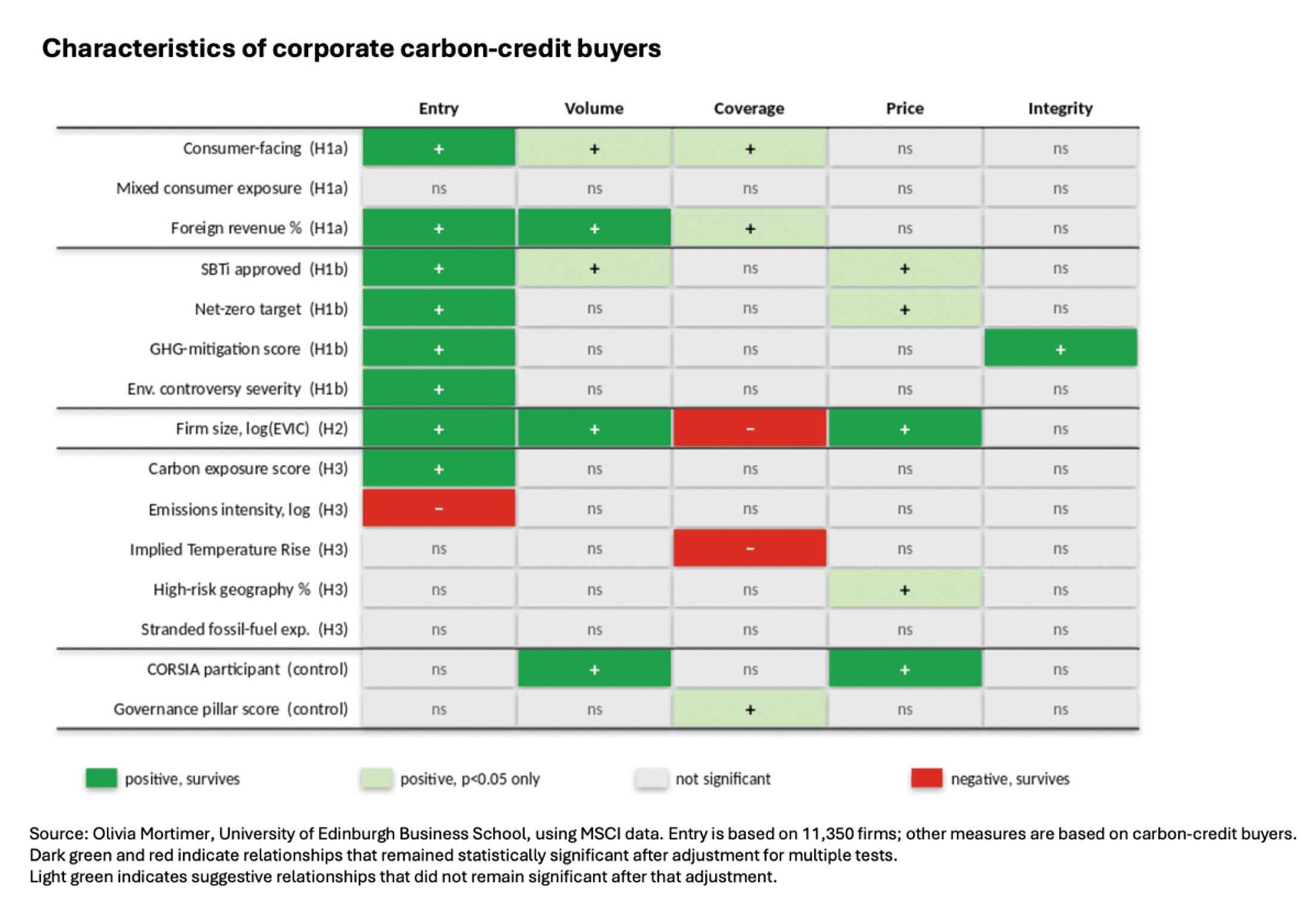
Company characteristics were much more revealing about whether a company bought carbon credits than about what it bought. Nine of the 15 company characteristics Mortimer tested were associated with whether a company bought carbon credits, and all nine held up to additional statistical testing. By comparison, only three characteristics were associated with the volume purchased, two with price and just one with the integrity of the credits.
Among the strongest signals was whether a company deals directly with consumers. Consumer-facing companies were 5.6 percentage points more likely to buy credits than business-facing companies, compared with a 19.9% overall buyer rate. Firm size mattered too. Larger companies were more likely to participate and bought more credits, but those purchases covered a smaller share of their emissions.
The contrast was sharpest for credit integrity. Of the 15 characteristics tested, only a company’s GHG-mitigation score — a measure of its demonstrated efforts to reduce emissions — was associated with the integrity of the credits it purchased. “The wider finding,” explains Mortimer, “is that the literature on voluntary environmental action transfers to this market at the point of entry and thins beyond it.”
Mortimer’s findings also line up with several signals MSCI’s Credit Buyer Profile already relies on. Companies with targets validated by the Science Based Targets initiative — one of the framework’s existing inputs — showed the single strongest association with entering the market, though that relationship appeared to weaken over the study period. Financial strength, a criterion in the framework’s ability-to-pay assessment, was associated with companies paying more per credit, supporting an existing element of MSCI’s approach.
For those trying to understand demand for carbon credits, the implication is straightforward: Company characteristics may offer useful clues about who will buy, while understanding what they will buy may require looking more closely at the characteristics of the credits themselves.