A building’s energy use can tell investors something about its value, but only when they have enough context to interpret it. Where building-level energy data is scarce, other information may help fill the gaps.
Those ideas shaped research by Da Wei Zhang and Ahmed Syalabi Seet Bin Azry, master’s students in the Sustainable and Green Finance Institute at the National University of Singapore (NUS), who developed their projects as part of the MSCI Institute’s Scholars Program.
Both students started with data on building-level energy usage intensity (EUI) but took it in different directions. Zhang examined how Singapore’s commercial property market interprets energy use when pricing buildings. Seet Bin Azry explored whether machine learning could use building characteristics and weather data to fill gaps in granular energy-use data.
Taken together, the projects illustrate both the potential and the limitations of building-level energy data. Zhang’s research shows how context can help investors interpret what energy use says about a property. The research by Seet Bin Azry highlights the additional data that may be needed to estimate energy use where building-level information is scarce.
Here’s an overview of each.
Why context matters when markets price building energy use
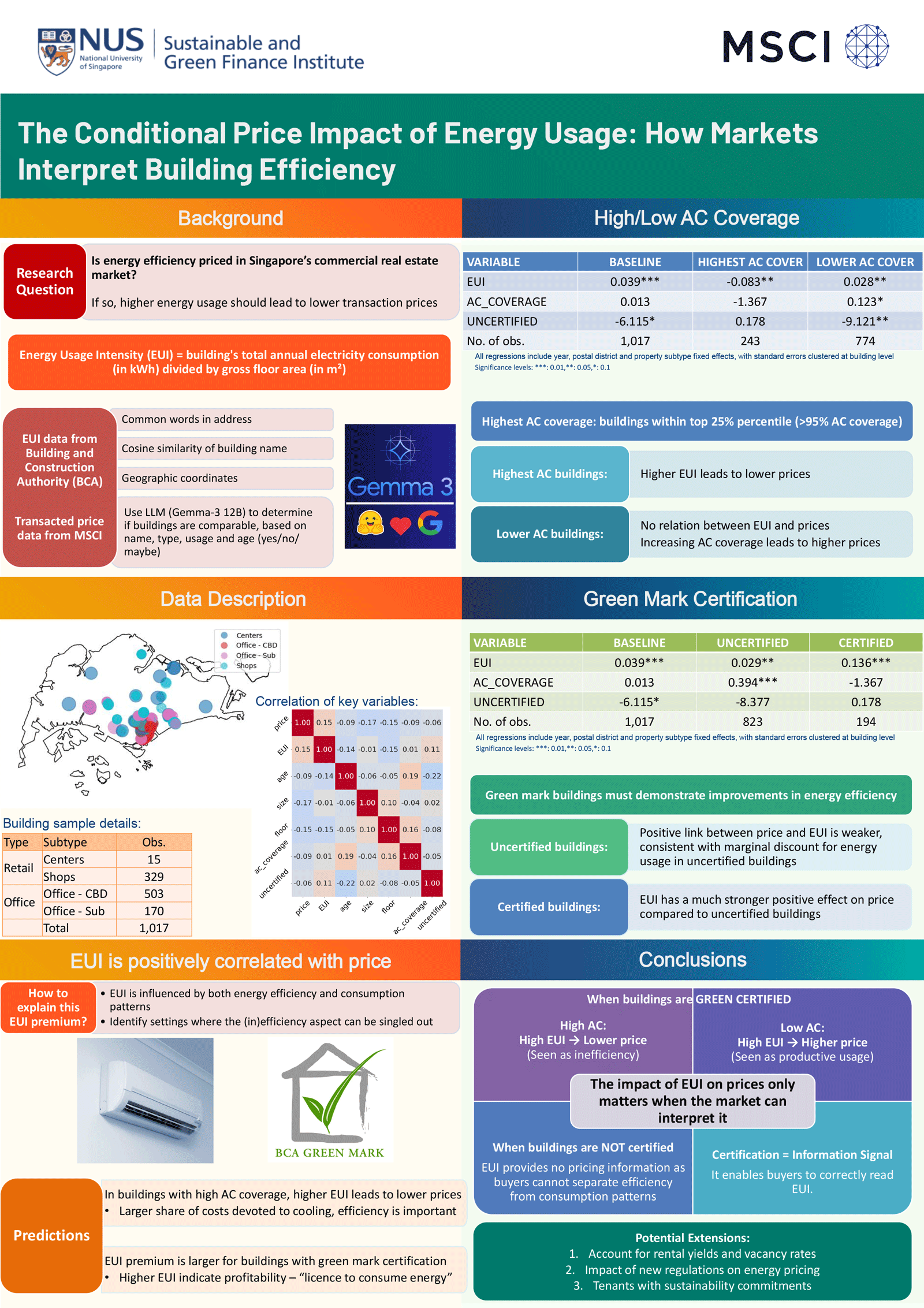
Da Wei Zhang set out to examine whether energy efficiency is priced into Singapore’s commercial real estate market. His research examined more than 1,000 transactions involving retail centers, shops and offices, combining EUI data from Singapore’s Building and Construction Authority with transaction-price data from MSCI. His findings suggest the answer depends less on energy use alone than on what investors can infer from it.
EUI, which measures annual electricity consumption per square meter, can reflect both how efficiently a building operates and how intensively it is used. In Zhang’s full sample, higher EUI was associated with higher prices. But EUI became a more meaningful pricing signal when buyers had additional context for interpreting what a building’s energy use represented.
Certification was one important signal. Among buildings certified under Singapore’s Green Mark program, the positive relationship between EUI and price was substantially stronger than among uncertified buildings. Zhang’s analysis suggests certification may give buyers additional context for interpreting energy use, helping them distinguish efficiency from consumption based on how a building is used.
Air-conditioning coverage revealed another distinction. Among buildings where air conditioning covered more than 95% of the property, higher EUI was associated with lower prices, consistent with greater energy use signaling inefficiency where cooling represents a large share of costs. In buildings with less air-conditioning coverage, higher EUI was associated with higher prices, potentially signaling more productive use — what Zhang describes as a “licence to consume energy.” The same measure, in other words, can carry different pricing signals depending on the context around it.
Zhang identifies several avenues for further research, including accounting for rental yields and vacancy rates, examining the impact of new energy-disclosure rules and exploring whether tenants’ sustainability commitments affect how energy use is valued.
Author: Da Wei Zhang
Academic supervisor: Johan Sulaeman, Director of the Sustainable and Green Finance Institute (SGFIN) at NUS, Dean’s Chair and a Professor in the Department of Finance at the NUS Business School
MSCI Institute supervisor: Cyril Pecoraro, Senior Data Scientist, MSCI Research and Development
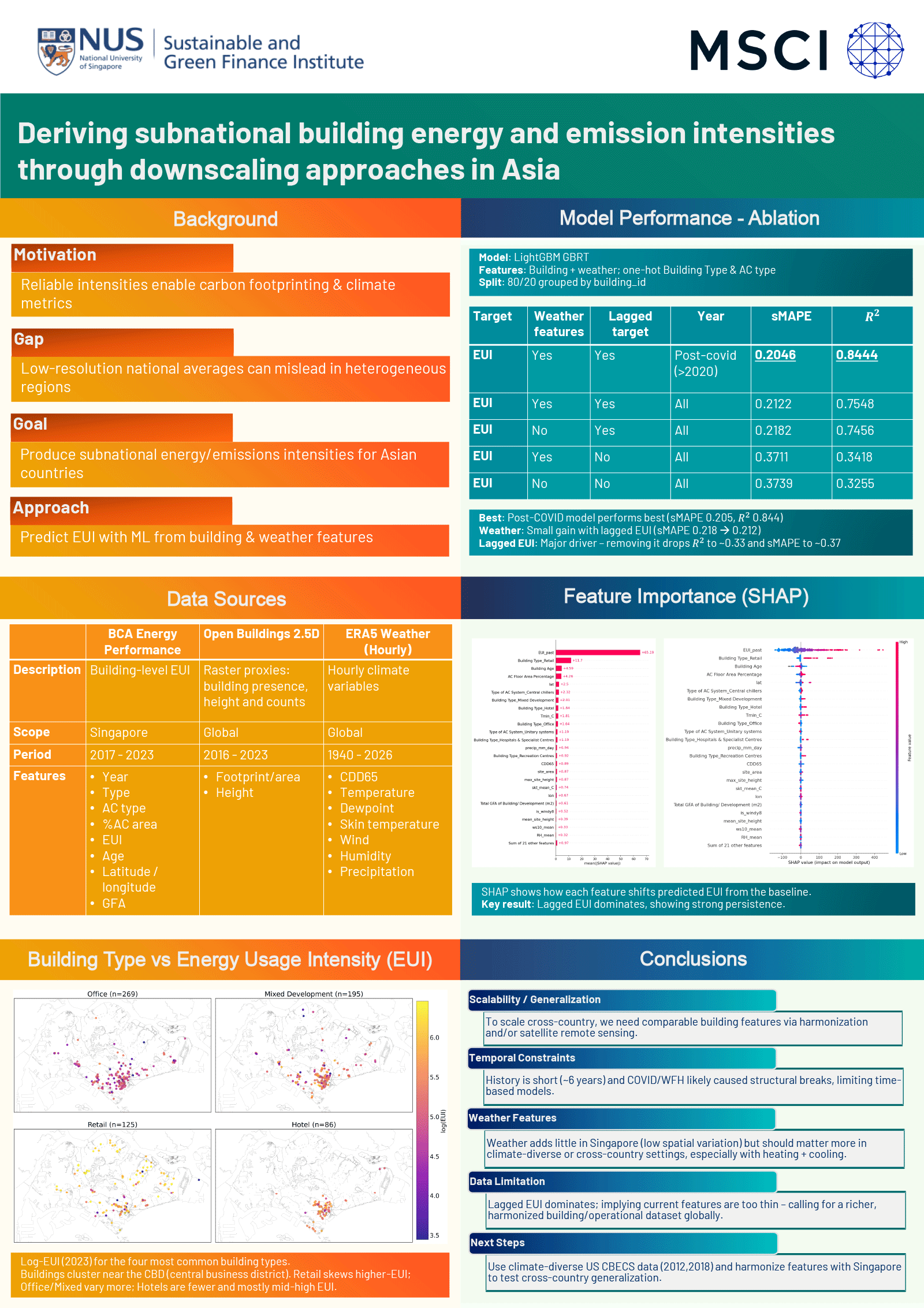
To project a building’s energy use, look to its past
A building’s energy use in the previous year may be a powerful predictor of its energy use in the next.
When Seet Bin Azry removed historical energy-use information from his machine-learning model, its ability to explain differences in energy use across buildings fell sharply. The result suggests that building energy use tends to persist from year to year and highlights the challenge of estimating it in markets that lack historical building-level data.
The research was motivated by a broader data challenge. Many Asian markets lack granular building-level energy data, leaving analysts reliant on national averages that can mask significant differences among buildings and locations. Seet Bin Azry tested whether machine learning could help produce more granular estimates by combining Singapore’s building-level energy data with information on building characteristics and weather.
The model performed well when a building’s previous energy use was available. Its best version explained about 84% of the variation in energy use among the buildings studied. Without previous-year energy use, however, that figure fell to roughly one-third. Weather information added relatively little in Singapore, where climate conditions vary less than they do across larger geographies. The researchers expect weather to matter more when the model is tested in markets with greater variation in heating and cooling needs.
The results point to both the promise and the current limitations of using machine learning to estimate building-level energy use. Extending the model across countries will require richer, more comparable information on buildings and their operations. The next step is to test the approach using more climate-diverse U.S. building data to see how well it generalizes beyond Singapore.
Author: Ahmed Syalabi Seet Bin Azry
Academic supervisor: Alminas Zaldokas, Associate Professor in Finance at NUS
MSCI Institute supervisor: XinXin Wang, Executive Director, MSCI Research & Development