Climate adaptation is already an investable opportunity in public markets. The question is whether investors can see it.
A new report from the MSCI Institute applies an improved AI-assisted methodology to listed companies – representing roughly USD 96 trillion in global market capitalization – to answer two questions that matter for investors:
- Which companies are investing to build resilience in their own operations against physical climate threats?
- Which companies are generating revenues from products that help customers, communities and governments adapt?
The findings reveal far broader corporate engagement with adaptation and resilience than conventional disclosures suggest:
- Most (89%) companies analyzed show evidence of at least one hazard-specific activity to strengthen operational resilience – spanning asset hardening, supply chain adjustments, workforce protections and emergency-response capabilities.
- Roughly half are generating revenues from resilience-enabling products, cutting across every sector and every major physical hazard category.
- The opportunity is present across the publicly listed universe today and can be accessed without relying solely on private markets or specialist vehicles.
We find that a large majority of listed companies have identifiable activities related to adaptation and resilience, with activities aimed at risk management of corporate operations and supply chain outweighing activities for revenue generation. Among the peer set analyzed, 89% showed evidence of at least one physical hazard-specific activity that enhances adaptability and resilience of their corporate operations. By contrast, just under half (47%) demonstrated activities tied to product offerings sold to customers to enable their resilience.
Corporate resilience activities: Risk management vs. Revenue generation
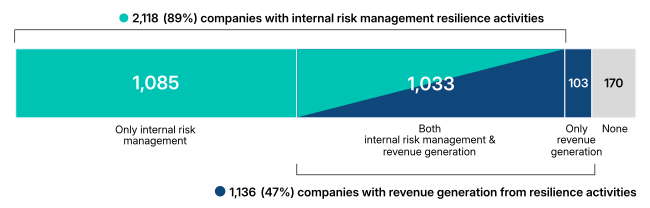
Source: MSCI Institute analysis of company data. Research universe comprised of the constituents of the MSCI ACWI Index, as of January 2026.
The report builds on the Institute’s 2024 collaboration with the Global Adaptation & Resilience Investment (GARI) working group, “The Unavoidable Opportunity,” and substantially extends it with an AI-based methodology that can be generalized to support thematic investing beyond climate adaptation. Our latest analysis uses a large language model to process roughly 900,000 tokens of information per company (compared with roughly 1,000 in our original analysis).