Pam Palena, Sustainability & Climate Research, MSCI | Lauren Yeung, Research Analyst, MSCI Institute
Key findings
- Insurers who are further along in their management of financially relevant sustainability risks appear to have better withstood shocks and periods of stress, based on a comparison of U.N. Principles for Sustainable Insurance (PSI) signatories and non-signatories within MSCI’s ESG Ratings coverage over five years that ended Dec. 31, 2024.
- PSI signatories observed tend to be at a more mature stage in adopting practices to manage sustainability risks in underwriting and investments compared with non-signatories.
- Signatories’ stronger management of sustainability risks coincides with their attracting a larger share of investments indexed to MSCI’s Sustainability and Climate Indexes, as of June 30, 2025.
The sustainability commitments of insurers may provide a window into their resilience to financially relevant risks.
Insurers that tend to be further along in their management of financially relevant sustainability risks in both underwriting and investing saw smaller declines in profitability during periods of market volatility compared with industry peers, according to an MSCI Institute analysis comparing U.N. Principles for Sustainable Insurance (PSI) signatories with non-signatories within MSCI’s ESG Ratings coverage over the five years ended Dec. 31, 2024.[1]
While the sample sizes — 28 PSI signatories and 26 non-signatories in the EMEA and Asia-Pacific regions — can only be indicative and not conclusive, the findings echo research by MSCI showing that life insurers with stronger responsible-investment practices in financial years 2022–2024 experienced smaller declines in investment returns in the weakest years and greater stability overall.[2]
The PSI, which counts more than 170 signatories as of December 2025, offers a global framework for insurers to address sustainability risks and opportunities. The framework comprises four principles that, taken together, require signatories to integrate sustainability into their strategy, decision-making and actions.
“PSI signatories appeared to have better withstood shocks and periods of stress,” write co-authors Pam Palena, an MSCI Institute fellow, and the Institute’s Lauren Yeung. “The data suggests that the benefit of sustainability commitments for the groups observed may lie more in resilience than in returns.”
The analysis, which bookends an analysis by the MSCI Institute of the sustainability commitments of banks, explores insurers’ management of sustainability risks in both underwriting and investing. The analysis finds that PSI signatories tend to be at a more mature stage in adopting practices to manage sustainability risks in underwriting and investments compared with non-signatories.
Return on equity

Source: MSCI Sustainability & Climate Research and FactSet, based on data as of Sept. 1, 2025, based on 28 PSI signatories and 26 non-signatories. Excludes brokerage to ensure compatibility. Excludes regional industry segments with less than three companies. PSI groups include companies that remained signatories throughout the analysis period. For more information see report.
Underwriting
Majorities of PSI signatories observed, for example, conducted in-house research to quantify the impact of extreme weather events and other physical impacts of a warming world on their underwriting portfolio (58%) and factored forward-looking climate analysis into underwriting, risk management and other decisions (56%), compared with 19% of non-signatories.
Signatories also incorporated climate change-related risks in their underwriting models ahead of market and regulatory pressures: 100% of signatories observed had done so over the nine years ended September 2025. While some non-signatories also had adopted this practice early, adoption among non-signatories played catch-up to signatories, rising from 38% to 78%, over the same period. The increase coincided with both record losses from natural catastrophes in 2017-2018 and, between 2021 and 2023, new guidelines on the use of climate change risk from the insurance supervisory authority in the European Union.[3]
Incorporation of climate risks in underwriting models
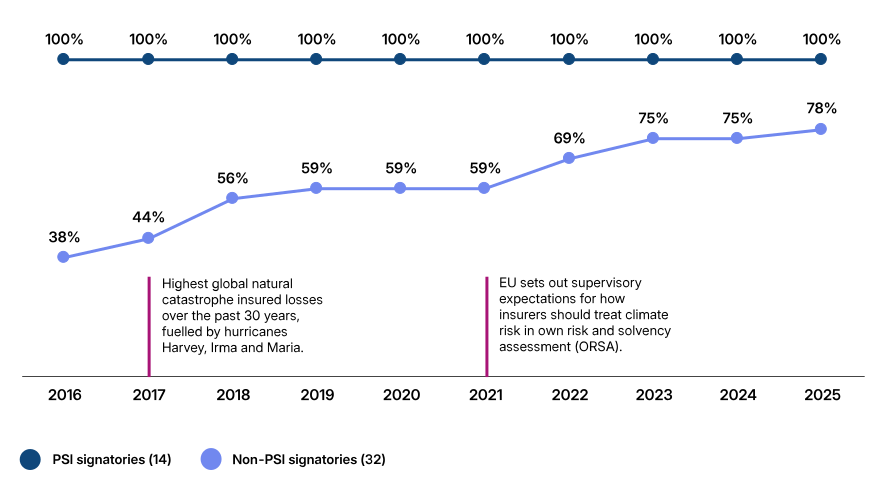
Source: MSCI Sustainability & Climate Research, data as of September 2025. For more information see report.
Investments
Most (88%) PSI signatories observed have policies designed to integrate sustainability considerations into investment decisions, compared with just over half (55%) of non-signatories. In addition, 71% of signatories have published policies governing engagement or proxy voting on sustainability issues, compared with 35% of non-signatories.
Taken together, the findings suggest that PSI signatories have tended to integrate sustainability earlier and more systematically than non-signatory peers, with a tighter tie between risk-management practices and long-term business planning.
Responsible-investment policies by investment stages
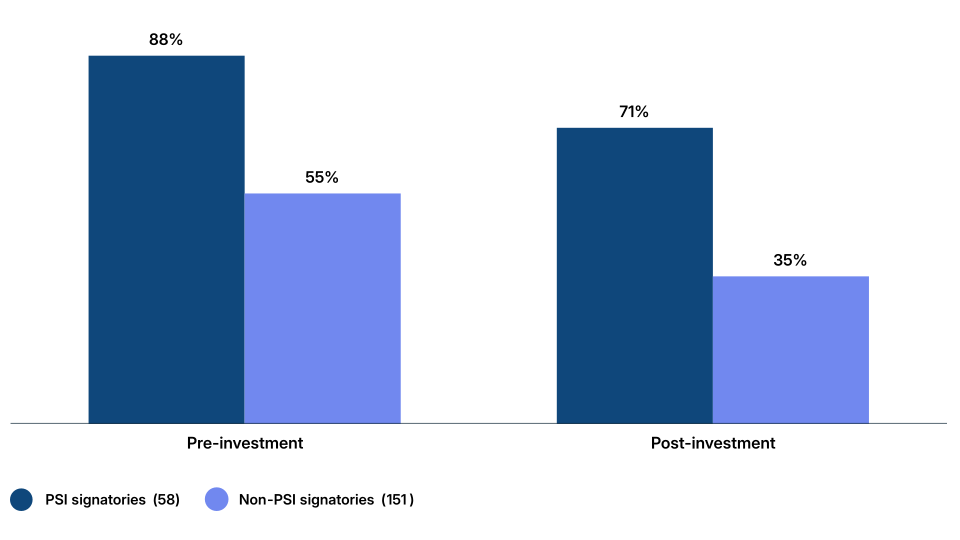
Source: MSCI Sustainability & Climate Research, data as of September 2025.
Attracting capital
PSI signatories’ stronger management of sustainability risks coincides with their attracting a larger share of investments indexed to MSCI’s Sustainability and Climate (S&C) Indexes, tracked by over USD 1 trillion of assets as of June 30, 2025. The chart at left shows that signatories attracted 50% more of S&C indexed assets under management (an additional 0.05%) compared with non-signatories, as of June 2025, after normalizing for market capitalization.
While the inclusion of companies in indexes reflects a series of factors, the finding for PSI signatories mirrors research by MSCI showing that companies that most effectively managed their financially relevant sustainability risks have attracted significantly larger indexed capital flows.
Attracting indexed assets under management
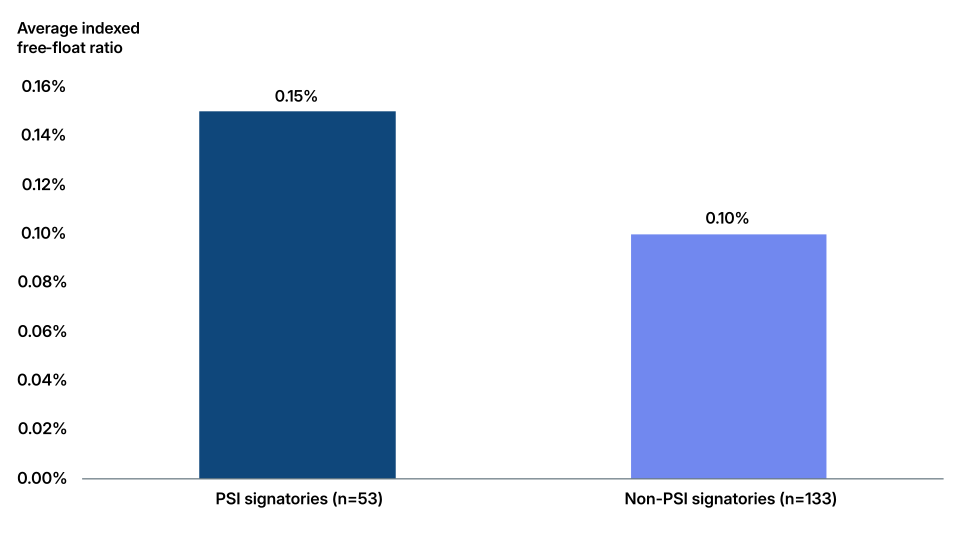
Source: MSCI Sustainability & Climate Research, data as of June 2025. The chart shows the indexed free-float ratio (total indexed assets under management (AUM) divided by free-float market capitalization). The indexed free-float ratio compares a company’s indexed AUM across all MSCI Sustainability & Climate Indexes that include the company with the shares available for public investors, showing whether the company attracts more or less indexed investment than its size alone would suggest.
Overall, PSI signatories lead non-signatories in managing financially relevant sustainability risks and opportunities, the analysis finds. Seventy-three percent of PSI signatories are rated by MSCI as industry leaders in managing sustainability risks, compared with 30% of non-signatories.[4] At the same time, one-fifth of non-signatories are rated by MSCI as laggards in managing such risks, compared with no PSI signatories in that category.
References
[1] The analysis compares PSI signatories within MSCI’s ESG Ratings coverage with non-signatories in the property & casualty insurance, life & health Insurance, and multi-line insurance & brokerage industries, based on data as of Sept. 1, 2025. A majority (57%) of PSI signatories within MSCI’s sustainability ratings coverage are domiciled in the EMEA region, with 29% in Asia and 14% in the Americas, as of September 2025. That contrasts with non-signatories, a majority (58%) of whom are located in the Americas, with 22% in EMEA and about a fifth in APAC.
[2] “Industry Report | Life & Health Insurance,” MSCI Sustainability & Climate Research, July 2025 (subscription required to access).
[3] See, for example, “Natural catastrophes and man-made disasters in 2017: a year of record-breaking losses,” Swiss Re Institute, 2018. See also, “EIOPA issues Opinion on the supervision of the use of climate change risk scenarios in ORSA,” The European Insurance and Occupational Pensions Authority, April 19, 2021.
[4] Ratings reflect companies’ MSCI ESG Rating, an industry-relative, seven-point letter rating scale from AAA to CCC. Leaders comprise companies rated AAA or AA, while laggards comprise those rated B or CCC. For more information, see “ESG Ratings Methodology,” MSCI Sustainability & Climate Research, April 2024.
