Linda-Eling Lee, founding director, MSCI Institute | Chris Cote, executive director, MSCI Research & Development | Umar Ashfaq, research director, MSCI Institute
Friday marks 10 years since nearly 200 countries met in Paris during the United Nations climate negotiations and agreed to adopt the 27-page accord.
The intervening decade has seen a step-change in private-sector investment in the shift to a cleaner, more resilient global economy, as the latest edition of MSCI Institute’s Transition Finance Tracker shows.
But what might have happened with corporate climate progress in a world without the Paris Agreement?
Stepping back in time to the eve of the accord, only a small portion of the world’s largest companies paid sufficient attention as to track their direct greenhouse gas emissions. For the corporate world, the Paris Agreement represented an inflection point that:
Triggered a steeper trajectory of decarbonization.
Even among companies that had already started to manage their emissions, their emissions fell much faster following the Paris Agreement, at roughly -3% per year, compared with being roughly flat in the three years that preceded it. While still not sufficient to meet the Paris goals, it represents almost 25% less emissions per year from these companies than in a world without the Paris ambition.
The chart compares two trajectories for the roughly 1,350 listed companies that had already been reporting their Scope 1 emissions for some years leading up to the Paris Agreement. In one trajectory, the companies continued to emit at the same rate as in the years before the climate accord, when their emissions were more or less flat. In the other, we chart their emissions as reported each year since the Paris Agreement, when their emissions fell at an average annual rate of 3%, a notable acceleration.
Corporate carbon cutting since the Paris Agreement (gigatons of CO2e)

Source: MSCI Institute, based on 1,352 companies that have reported their Scope 1 emissions continually throughout the period 2012 to 2023. Emissions for 2024 and 2025 estimated.
Ignited a transparency movement.
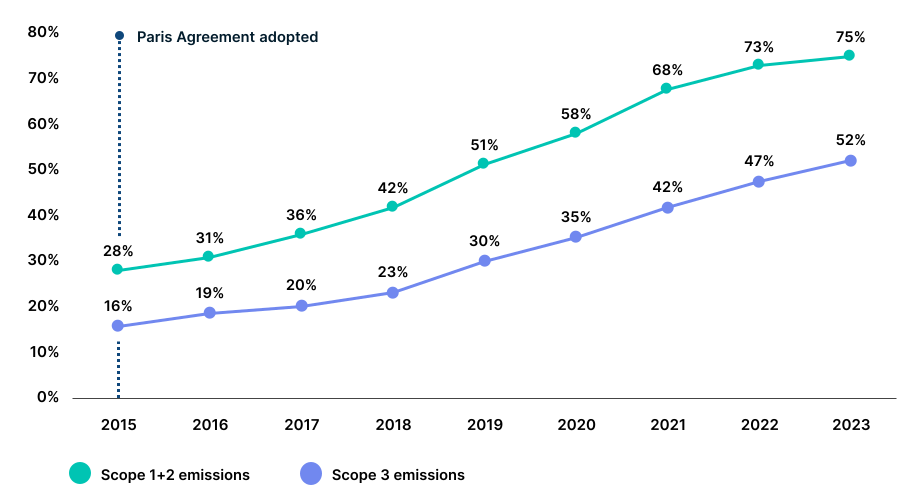
A rush of companies started to track and report their emissions, post the Paris Agreement. At least three-quarters (75%) of the world’s listed companies disclose their Scope 1 and 2 emissions, compared with 28% on the eve of the Paris Agreement.[1] Thanks in part to initiatives such as the Task Force on Climate related Financial Disclosures and its successor, the International Sustainability Stanards Board, today investors have much more climate-related financial information now than they did on the eve of the Paris Agreement.
Emissions disclosure by listed companies (%)
Source: MSCI ESG Research, data as of Sept. 30, 2025.
To be sure, corporate emissions still point past the Paris Agreement’s limits, and the costs of a warming world continue to rise. Whether the world can change course remains unclear. But as the experience of the past decade suggests, companies are paying attention and can take action.
References
Further reading