The latest United Nations report released in the run-up to COP30 warns that the word is on track for warming between 2.3°C and 2.8°C above preindustrial levels, depending on how fully countries implement their carbon commitments. Yet some companies, and the investors who hold their stocks, continue to claim alignment with 1.5°C, the science-based threshold for preventing the costliest warming. This isn’t a contradiction, it’s a measurement challenge.
The challenge lies in companies managing what remains of their own share of the world’s remaining 1.5°C carbon budget, which reflects how much carbon dioxide can still be emitted while keeping global warming within that threshold. The destination may be net-zero by 2050, but the journey – managing the emissions that remain before average global temperatures cross that threshold – makes all the difference. This is the main purpose of alignment metrics, as I detailed in an earlier blog post.
Alignment metrics recognize that companies have their own emissions trajectories, and that investors may care about the alignment of their investments with global climate goals, whether because they aim to generate an environmental outcome alongside financial return, reduce energy-transition risk or satisfy regulatory demands.
Note, however, that there’s no one true way of determining a company’s carbon budget. Hence, varying methods of assessing corporate carbon budgets that we group as either static or dynamic approaches shape our understanding of whether companies and portfolios align with the goals of the Paris Agreement, which aims to limit warming to well-below 2°C while pursuing efforts to stay below 1.5°C.
That methodological choice can materially change how investors report Paris alignment and whether they face reputational or regulatory risk from mischaracterizing it, as Jesica Andrews of the UN Environment Programme Finance Initiative, Giorgis Hadzilacos of M&G Investments and I detail in a new research paper that I summarize below.
Static-budget alignment metrics: Simple and practical
A static-budget approach assesses alignment with temperature targets using fixed values based on the remaining global 1.5°C budget as of a certain date, such as 2020. A company, for example, must reduce absolute emissions by 5% per year to stay on track for 1.5°C, based on a global pathway over the period 2020 to 2050. The intuitiveness and stability of static-budget benchmarks results in their being widely used, including by the Science-Based Targets initiative (SBTi) to validate corporate decarbonization targets under some of its methodologies.
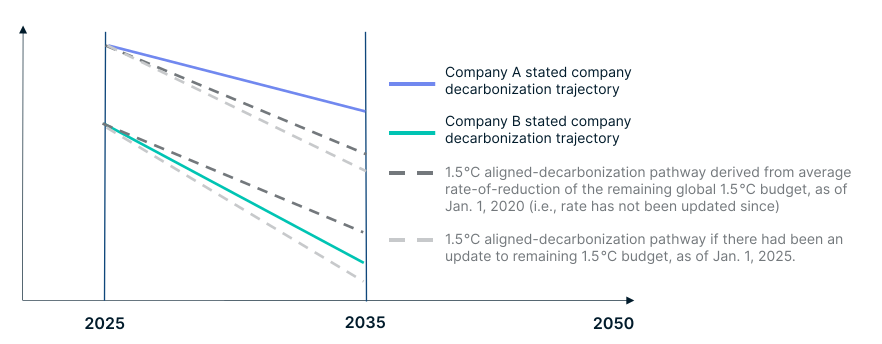
Here’s the catch. Static carbon budgets, as the name suggests, show little change; they don’t update to reflect that countries have used more of the global carbon budget than originally expected (Exhibit 1). Global emissions have continued to rise since 2020, but the global carbon budget hasn’t. Since 2020, the deviation from 1.5°C has only become more distorted.
Exhibit 1: Static budget approach (MtCO2e)
Source: MSCI Institute
In practice, this can lead to mislabeling. A company that starts to decarbonize in 2025 at 5% a year based on a 1.5°C-aligned budget set in 2020 is already missing the mark. The static approach also prevents the aggregation of companies’ emissions trajectories into one overall temperature alignment (such as a portfolio aligned with a 1.8°C trajectory, for example). At best, investors can point to percentages; for example, 20% of the portfolio aligns with an emissions trajectory of 1.5°C. Nor can investors balance between higher corporate emissions trajectories with lower ones in their portfolio. For portfolios, funds and indexes, this means missing information.
Nonetheless, alignment metrics are not scientific tools. And static-budget metrics are practical when it comes to portfolio allocation or company target-setting. The performance benchmark doesn’t move.
Dynamic-budget alignment metrics: Accurate and aggregable
Unlike static-budget metrics, a dynamic-budget metric allocates a share of the global carbon budget to each company or portfolio from a certain baseline year (again, for example, 2020), but continues to monitor how both companies’ realized emissions and their likely trajectories would consume the company’s share of the global budget.
Dynamic approaches share with a static approach one key insight: Even in a world warming beyond 2°C above preindustrial levels, an asset or portfolio can still align with 1.5°C, provided it stays within its allocated share of a 1.5°C-aligned carbon budget. That’s not greenwashing, but a recognition that some companies (or countries) can stay within their fair share of a global carbon budget even as others overshoot.
Dynamic approaches differ, however, in that the rate at which a company needs to decarbonize to remain aligned with 1.5°C is likely to evolve. A company that burns through its share of the carbon budget year after year would need to reduce emissions more steeply in the future to remain 1.5°C-aligned. Earlier this year, the SBTi, whose standards have rested so far on the static-budget approach, acknowledged the virtue of a dynamic company-specific budget logic for companies that may seek to course-correct and achieve their 1.5°C targets in a nonlinear way.
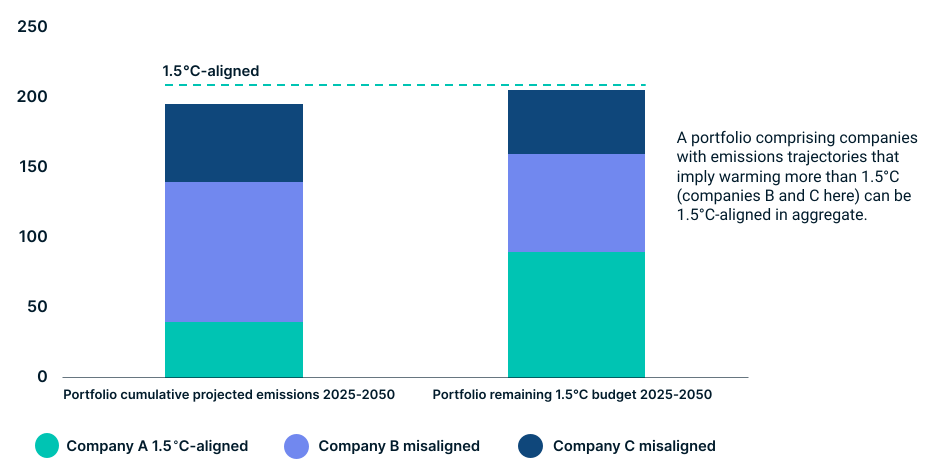
A key advantage of the dynamic approach for investors is in aggregating emissions of multiple companies. A dynamic approach means that a portfolio may comprise companies with a mix of projected emissions, some that align with global climate goals and others that don’t. At the same time, if the portfolio overall – the cumulative projected emissions of all companies – stays under its overall allocated emission budget, it may yet be Paris-aligned. In other words, it reflects a pooling of both the fair share budget and the emissions of the companies. (The Glasgow Financial Alliance for Net-Zero has recommended that investors aggregate portfolio emissions rather than require all companies to decarbonize at the same rate.)
Exhibit 2: Illustrative portfolio examples with dynamic-budget approach (MtCO2e)
Source: MSCI Institute
Note that this degree of accuracy can present a challenge. As companies’ temperature alignment evolves, so does the portfolio’s. This adds to the complexity that already comes with setting company-specific carbon budgets.
The map is not the territory, yet we need it
As this post implies, there is no such thing as a perfect alignment metric, only varied approaches that each hold advantages and disadvantages (Exhibit 3). Static-budget tools offer simplicity, while dynamic-budget tools provide accuracy. What matters is knowing what you’re measuring and why you’re measuring it.
Exhibit 3: Comparing corporate carbon budget approaches
| Static-budget approach | Dynamic-budget approach | |
|---|---|---|
| Advantages |
|
|
| Disadvantages |
|
|
| Methodologies |
|
|
Source: MSCI Institute
The implications for investors are significant. The choice of method can determine whether funds, for example, meet the threshold for alignment with global climate goals under varying disclosure frameworks. It can also influence capital allocation, risk management and reputational exposure.
Alignment metrics may differ in their methodologies, but agree on one thing. The global economy may be misaligned with the goals of the Paris Agreement, but certain companies and portfolios may follow a Paris-aligned path.